

Textile industry of Ukraine: potential for creating modern production of technical and military fabrics
The development of the textile sector for Ukraine is not only of economic but also strategic importance, as it allows for the creation of added value within the country, the creation of jobs, and the reduction of dependence on imports.
Analysis of the Ukrainian fabric market over the past 30 years: from loss of production capacity to the formation of new demand
The Ukrainian textile industry has undergone a complex transformation over the past three decades. In the early 1990s, the country had one of the largest production potentials in Eastern Europe. Dozens of large textile factories operated in Ukraine, providing a full production cycle — from fiber spinning to the production of finished fabrics and their finishing.
After gaining independence, the textile industry of Ukraine underwent significant structural changes. A significant part of the full-cycle enterprises that provided the production of fabrics for the clothing industry reduced their activities or ceased operations. As a result, Ukrainian clothing manufacturers increasingly focused on imported raw materials, primarily synthetic, membrane and specialized technical fabrics. This trend led to the growing dependence of the domestic market on external suppliers and the strengthening of the role of imports in meeting the needs of light industry.
At the same time, light industry remains an important component of the Ukrainian economy. According to the State Statistics Service of Ukraine, published by the Ukrlegprom association, the volume of sales of light industry enterprises in 2024 amounted to UAH 47.28 billion (excluding VAT). The largest share in the sales structure was occupied by clothing production — 44%, while the production of other textile products accounted for 26%, and weaving production — about 3%.
A separate development direction is the segment of technical textiles, the demand for which is growing under the influence of the needs of the defense sector, construction, transport, medicine and industry. However, due to the lack of official state statistics on the volume of this segment, its market capacity can only be assessed by experts (UKRLEGPROM https://ukrlegprom.org/ua/news/struktura-obsyagu-realizovanoyi-produkcziyi-legkoyi-promyslovosti-ukrayiny-u-2024-roczi/?utm_source=chatgpt.com).
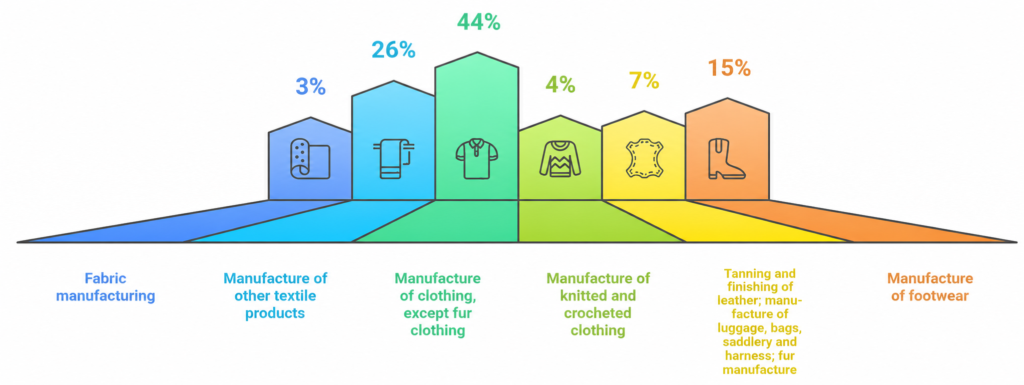
Фактично сьогодні в Україні сформувався парадоксальний ринок: країна має тисячі швейних підприємств, стабільний попит на спеціальні тканини та значний експортний потенціал, але при цьому значною мірою залежить від імпорту тканин і технологій їх виробництва. Саме ця обставина створює передумови для появи нових виробництв повного циклу.
Структура імпорту тканин в Україну у 2020–2025 роках (до та після повномасштабного вторгнення)
During 2020–2025, the Ukrainian textile materials market was characterized by high dependence on imported supplies. The main reasons were the reduction in domestic fabric production, insufficient investments in the modernization of textile enterprises, and the growth in demand for modern synthetic, membrane, and technical materials, which are produced in Ukraine in limited volumes.
According to the State Statistics Service of Ukraine, textile materials and textile products consistently form a significant share of Ukrainian imports. According to the results of January-August 2024, imports of products of group XI of the Ukrainian Customs Union of Foreign Economic Activities (“Textile materials and textile products”) amounted to 1.56 billion US dollars, which corresponded to about 3.5% of the country’s total imports. At the same time, the volume of imports exceeded exports of similar products almost four times.
In 2024, total imports of goods into Ukraine reached 70.7 billion US dollars, which is 13% more than in 2023. China, Poland and Germany remained Ukraine’s largest trading partners in terms of imports. These countries, along with Turkey, are key suppliers of textile materials for Ukrainian light industry.
An analysis of the structure of fabric imports shows that in 2020–2025 the following categories dominated:
- synthetic and blended fabrics for the production of everyday clothing;
- knitted fabrics;
- membrane fabrics for special and military clothing;
- technical textiles for industry, transport and construction;
- non-woven materials used in medicine and personal protective equipment.
After 2022, there was a significant increase in demand for special military fabrics. The activation of defense orders stimulated the import of materials for the manufacture of military uniforms, body armor, equipment and personal protective equipment. As a result, purchases of polyamide, polyester and membrane fabrics from the European Union and Asia significantly increased.
Geographical structure of imports (leading positions)
| Country | Main Types of Fabrics |
| China | Synthetic fabrics, polyester, technical textiles |
| Turkey | Cotton and blended fabrics, knitted fabrics |
| Poland | Technical fabrics, specialized textiles, fabrics for workwear and protective clothing |
| Germany | High-performance textiles, membrane materials |
| Italy | Premium fabrics for the fashion industry |
It should be noted that after the outbreak of the full-scale war, there was a partial reorientation of import flows from Asian markets to suppliers from the European Union. This process was associated with the need to reduce logistical risks and ensure the stability of supplies for light industry enterprises.
Thus, in 2020–2025, the Ukrainian fabric market remained import-dependent, especially in the segments of synthetic, membrane, and technical materials. At the same time, the growth of domestic demand for specialized textiles creates the prerequisites for the development of domestic production of high-tech fabrics and a gradual reduction in dependence on external suppliers.
Critical dependence on imported materials
| Category | Import Share |
| Membrane fabrics | 90–100% |
| FR fabrics (fire resistant) | 80–95% |
| IRR fabrics for military uniforms | over 90% |
| Technical synthetic fabrics | 70–90% |
| Special accessories | over 80% |
Why is the demand for technical textiles growing?
Among the enterprises that continue to produce textile materials in Ukraine, it is worth noting Teksterno, Cheksil, Edelvika and a number of other specialized manufacturers. However, the modern structure of the industry is characterized by the predominance of enterprises specializing in sewing finished products, while individual stages of textile production – yarn production, weaving, dyeing, application of functional coatings and special processing of fabrics – are much less developed.
According to the Ukrlegprom association, in 2024, the volume of sales of light industry in Ukraine amounted to UAH 47.28 billion, of which only about 3% fell on weaving production, while the largest share was formed by clothing production (44%). This structure indicates the predominance of processing operations over the production of domestic textile materials and the preservation of significant dependence on imported raw materials.
Import dependence is particularly pronounced in the high-tech textile segments. Membrane, flame-resistant (FR), infrared-shielding (IRR) fabrics, as well as a significant part of synthetic technical materials, come mainly from the European Union, Turkey, South Korea and China. This is due to the high capital intensity of the relevant industries, the need for specialized equipment and complex processing processes.
As a result, a situation has developed in which Ukraine has significant domestic demand for technical and military textiles, a developed network of sewing enterprises and stable government orders, but at the same time is significantly dependent on imported fabrics and technologies. According to the State Customs Service of Ukraine, in 2024, imports of goods of group XI “Textile materials and textile products” exceeded 2 billion USD, which confirms the important role of external supplies in meeting the needs of domestic light industry. This creates economic prerequisites for the development of full-cycle textile production in Ukraine, capable of ensuring the production of yarn, fabrics, dyeing and special processing of materials for the defense, industrial and civilian sectors.
After the outbreak of the full-scale war, the structure of demand for textile products changed significantly. The following segments experienced the most dynamic development:
- military textiles;
- special and protective clothing;
- medical textiles;
- industrial protective fabrics;
- waterproof and membrane materials.
The impact of the defense sector on the development of the industry is confirmed by the structure of government procurement. According to market participants and industry associations, after 2022, the production volumes of military uniforms, equipment and personal protective equipment increased significantly, which caused a sharp increase in demand for specialized fabrics and materials. As a result, the defense sector has become one of the key drivers of the development of the Ukrainian market of technical textiles and workwear, stimulating both the expansion of production capacities and the search for opportunities to localize the production of high-tech materials.
Full-cycle fabric production: from cotton fiber to finished special textiles
One of the key features of the modern textile industry is the high added value that is created at each stage of the production cycle. That is why leading European manufacturers of technical and military fabrics strive to control the entire process – from fiber processing to the production of finished fabric with special protective properties.
For Ukraine, the development of full-cycle enterprises is of particular importance, since a significant part of these technological operations is currently performed outside the country.
Yarn production: the first stage of added value creation
The basis of most fabrics for workwear and military uniforms remains cotton or a blend of cotton and synthetic fibers. Global cotton production exceeds 24–25 million tons per year.
Table of the largest manufacturers
| Country | Share of world production |
| China | about 25% |
| India | about 23% |
| USA | about 13% |
| Brazil | about 10% |
After cleaning the cotton fiber, the process of carding and spinning is carried out. Modern enterprises use automated spinning lines that allow the production of tens of thousands of tons of yarn annually.
For the production of military fabrics, the following are most often used:
- cotton yarn;
- polyester yarn;
- blended yarn;
- aramid fibers for fire-resistant fabrics.
According to industry experts, yarn production itself accounts for up to 25–35% of the cost of future fabric. That is why countries that have their own spinning capacities are much less dependent on external suppliers.
Raw fabric production
After the yarn is made, the weaving process begins. At this stage, the so-called greige fabric is formed – a material without color and special protective properties.
Fabrics used to make military uniforms of NATO armies
| Fabric Type | Composition |
| blend twill | 50% cotton / 50% polyester |
| polycotton | 65% polyester / 35% cotton |
| Rip-Stop | reinforced structure against tearing |
| FR-fabric | cotton + aramid fibers |
| Softshell | multilayer membrane construction |
It is at the weaving stage that the following are determined:
- fabric strength;
- tear resistance;
- breathability;
- product durability.
A modern, medium-scale weaving mill is capable of producing 8 to 20 million m² of fabric per year, depending on the range and level of automation.
Dyeing raw fabric
One of the most complex and expensive stages is dyeing and finishing production. This process remains one of the most scarce in the Ukrainian textile industry today.
After weaving, the fabric goes through:
- bleaching;
- mercerization;
- dyeing;
- drying;
- heat setting;
- special finishing.
Comparison of basic fabric dyeing technologies for workwear and military textiles
| Indicator | Reactive dyeing | Dipping dyeing |
| Main purpose | Industrial workwear, corporate wear, civilian textiles | Military textiles, workwear for extreme conditions |
| Type of fibers | Cotton, viscose, natural fibers | Mostly cotton and cotton blends |
| Color fastness to washing | High | Very high |
| UV resistance | Medium-high | High |
| Abrasion resistance | High | Very high |
| Durability | High | Maximum among traditional technologies |
| Dyeing uniformity | Very high | High |
| Process cost | Lower | Higher due to more complex technology |
| Application in military uniforms | Limited | Widely used |
| Use for camouflage fabrics | Possible | Recommended for military fabrics |
| Compliance with defense sector requirements | Partial | High |
| Prevalence in EU countries | Widely used | Actively used by military textile manufacturers in Poland, Belgium, France and Spain |
Conclusion: Reactive dyeing is the optimal solution for the production of industrial workwear and civilian textiles due to its relatively lower cost and high dyeing quality.
Dipping dyeing requires higher production costs, but provides maximum color fastness to intensive use, repeated washing, and environmental exposure, making it one of the key standards for the production of military fabrics.
Applying military camouflage
After basic dyeing, the fabric is printed with a camouflage pattern. Modern NATO military fabrics are made using:
- rotary printing;
- digital printing;
- multi-stage pigment printing.
At this stage, camouflage is formed:
- MultiCam;
- MTP;
- MM-14;
- other national patterns.
Camouflage printing itself is often a separate high-tech production area.
Special fabric treatment for military personnel
At the final stage, the fabric acquires functional properties.
IRR (Infra-Red Reflective) treatment reduces the visibility of a soldier in night vision devices. This technology is mandatory for most modern NATO armies. In Ukraine, industrial production of IRR fabrics remains limited, so a significant part of such materials is imported.
FR (Flame Resistant) treatment provides protection against open flame. The following fabrics are used:
- military;
- energy;
- metallurgists;
- rescue services.
Water-repellent treatment – DWR finish creates protection against moisture and dirt.
Membrane lamination is one of the most technologically advanced processes. A special membrane is applied to the fabric, which:
- does not let water through;
- allows steam through;
- protects from wind.
Membrane fabrics are one of the most import-dependent categories of the Ukrainian market today.
Creation of a textile plant in Ukraine
The cost of creating a modern textile production largely depends on the degree of vertical integration of the enterprise. If we are talking only about dyeing and finishing production, investments in a modern continuous dyeing and finishing line of fabrics usually range from 2 to 8 million euros, depending on the productivity, width of the fabric, level of automation and set of technological operations (https://www.monforts.de/en/products/?utm_source=chatgpt.com ). Such complexes may include lines for fabric preparation, continuous dyeing, drying, heat setting, calendering, application of functional coatings and wastewater treatment systems.
To create a full-fledged textile plant, which includes yarn production, weaving, dyeing and finishing of fabrics, significantly larger investments are required (https://www.brueckner-textile.com/en/products/details/techno-line-tt-glass-fibre-finishing-line.html?utm_source=chatgpt.com ). Based on the analysis of implemented projects in the European Union countries and the structure of capital expenditures of the industry, the following approximate categories of investments can be distinguished:
- small specialized technical fabric plant – 15–30 million euros;
- medium vertically integrated plant – 40–80 million euros;
- large full-cycle textile complex with its own yarn production, weaving, dyeing and special types of processing – over 100–150 million euros.
European experience shows that the most competitive are full-cycle enterprises. This model is widely used in Portugal, Italy, Germany and Turkey, where spinning, weaving, dyeing, finishing and manufacturing of finished products are combined within one production site. This allows you to reduce logistics costs, control quality at all 9 https://dataintelo.com/report/global-textile-finishing-machinery-market?utm_source=chatgpt.com ) stages of production and adapt faster to customer requirements.
Among the world leaders in the production and installation of textile finishing equipment, the German companies Monforts and Brückner, as well as the Italian-Swiss group Santex Rimar, stand out. Monforts positions itself as a world leader in the field of textile finishing and offers comprehensive solutions for continuous dyeing, drying, heat setting, coating and special fabric treatment. The company emphasizes that its technologies are used all over the world to create highly efficient and resource-saving production.
Brückner specializes in the production of complete lines for technical textiles, membrane materials, nonwovens, protective fabrics, lamination and functional coating. The company describes itself as a technological and market leader in the field of fabric finishing and technical textiles, and its equipment is used for the production of military, industrial and specialty materials.
Santex Rimar Group is one of the world’s leading manufacturers of equipment for textile finishing, technical textiles, lamination, impregnation and application of functional coatings. The Group combines production sites in Italy, Switzerland, China and India and invests about 4% of its annual turnover in research and development of new technologies.
In terms of price/performance, many new manufacturing plants in Europe are choosing Santex Rimar solutions as a compromise between premium German Monforts and Brückner technologies and the need to optimize investment budgets. At the same time, Monforts and Brückner are traditionally seen as reference suppliers for the production of high-tech fabrics, including military, protective and technical textiles.
For Ukraine, the most promising model is the phased creation of a textile plant. At the first stage, it may be advisable to launch a dyeing and finishing production and a section for special fabric processing (FR, IRR, water-repellent treatment, membrane lamination). In the future, it is possible to expand to a full production cycle with its own weaving and yarn production, which will gradually reduce dependence on imported fabrics and increase the added value created in Ukraine.
Scenarios for launching a textile plant in Ukraine: €20 million, €50 million, €100 million, Comparison of scenarios for creating a textile plant in Ukraine
| Main products | Dyed fabrics, special textiles | Fabrics for workwear and military uniforms | Full range of technical, military and civilian fabrics |
| Weaving production | Partially | Yes | Yes |
| Dyeing and finishing | Yes | Yes | Yes |
| FR processing | Yes | Yes | Yes |
| IRR processing | Yes | Yes | Yes |
| Membrane lamination | Partially | Yes | Yes |
| Yarn production | No | Partially | Yes |
| Annual capacity | 4–6 million m of fabric | 10–15 million m of fabric | 20–30 million m of fabric |
| Employees | 150–250 | 300–500 | 700–1200 |
| Main sales markets | Ukraine | Ukraine, EU | Ukraine, EU, NATO |
| Estimated payback period | 5–7 years | 6–8 years | 8–12 years |
Source: author’s assessment based on the technical characteristics of Monforts, Brückner, Santex Rimar equipment and analysis of implemented textile projects in EU countries.
The most realistic scenario for modern Ukraine is the average development scenario. It allows for the creation of vertically integrated production of fabrics for workwear, military uniforms, and the industrial sector without the need to immediately invest in a full cycle of yarn production.
The cost of such a project is estimated at 50–80 million euros, which corresponds to investments in modern textile enterprises in Central and Eastern Europe. The plant may include:
- weaving shop (rapier and air-jet looms);
- dyeing and finishing production;
- special coating section;
- quality control laboratory;
- production of fabrics with FR, IRR and water-repellent properties;
- own treatment facilities.
According to Monforts, the modern MONTEX heat-setting and finishing line can provide a wide range of operations with technical and specialty fabrics, including drying, heat-setting and application of functional coatings (Monforts Textile Finishing Technologies, 2025).
The experience of the Swedish company FOV Fabrics https://www.fov.se/ demonstrates that the greatest added value in the technical textile segment is formed precisely at the stages of dyeing, lamination, functional and protective treatment of fabrics, and not only at the weaving stage. Therefore, when creating a Ukrainian textile plant, the primary task should be to localize precisely the high-tech processes of finishing and special processing, which today remain one of the most import-dependent segments of the industry.
Sweden as one of the centers of production of special and military textiles in Europe
Sweden is one of the most developed European clusters in the field of technical, protective and military textiles. The Borås region plays a particularly important role, where a unique ecosystem has formed, combining manufacturing enterprises, research centers and specialized education. The key educational and scientific center is The Swedish School of Textiles, which is part of the University of Borås. The institution is considered one of the leading European research centers in the field of textile technologies, functional materials, circular economy and innovative fabric production. A number of companies work around this cluster, forming the basis of the Swedish specialty textile industry.
| Company | Specialization |
| FOV Fabrics | Technical fabrics for the military, workwear, tents, protective equipment and outdoor sector |
| Tranemo Group Flame-resistant (FR) | workwear for energy, industry and emergency services |
| Fristads | One of the largest manufacturers of work and protective clothing in Europe |
| Taiga AB | Clothing and equipment for the military, police, rescue and security services |
| SnigelDesign | Tactical equipment, modular carrying systems, backpacks and unloading systems |
| Saab AB | Defense systems and military equipment; creates demand for high-tech materials and components |
| W. L. Gore & Associates | Developer of Gore-Tex membrane technologies for military and special clothing |
At the same time, Sweden is one of the world leaders in the field of ecological waste management and the development of a circular economy. Thanks to the high level of recycling and energy utilization of waste, the country uses waste as an important resource for the production of heat and electricity. In some periods, its own waste is not enough to load the capacities of waste processing complexes, so Sweden imports waste from other European countries for further processing and energy generation. This approach demonstrates a high level of integration of environmental principles into the state’s industrial policy and creates favorable conditions for the development of sustainable textile production.
Of particular interest for Ukraine is the activity of FOV Fabrics. The enterprise specializes in the production of fabrics for military uniforms, special clothing and protective equipment, using modern technologies of dyeing, lamination and functional processing of textiles. It is such production that creates the greatest added value in the modern textile industry.
The experience of Sweden demonstrates that the competitiveness of the industry is ensured not by low labor costs, but by the concentration of technologies, scientific developments, specialized education, principles of circular economy and full-cycle production. The combination of an innovative textile cluster, environmentally friendly state policy and active cooperation between science and business has allowed Sweden to create one of the most effective models for the development of the textile industry in Europe. This model is now considered one of the most promising guidelines for the development of the Ukrainian market of technical, special and military fabrics.
The experience of Kazakhstan and Uzbekistan in creating full-cycle textile plants
In recent years, Central Asian countries have demonstrated successful examples of modernization of the textile industry through the creation of vertically integrated production complexes. Particularly illustrative are the cases of Uzbekistan and Kazakhstan, which in the early 2000s were largely suppliers of raw materials, but gradually moved to the development of high-value-added production.
Chinese investment plays an important role in these processes. The construction of textile factories in Central Asia with the participation of Chinese capital has become part of China’s broader strategy to transfer labor-intensive production outside the country and form new production centers along the transport corridors of the “One Belt, One Road” initiative. The main goal is to create vertically integrated cotton and textile clusters that cover the entire production cycle – from growing cotton to the production of finished clothing and textile products.
The largest projects are being implemented in Kazakhstan and Uzbekistan. In particular, in the Turkestan region of Kazakhstan, the Chinese corporation Xinjiang Lihua is implementing an investment project worth over 200 billion tenge (over 400 million USD) aimed at creating a modern full-cycle textile cluster. The strategic goal of the project is to transition from the export of raw cotton to the production of finished products with high added value and create new jobs in the region.
In Uzbekistan, dozens of textile clusters and joint ventures with foreign capital have been formed over the past decade. Investments are particularly actively attracted to the Navoi and Urgut free economic zones, where projects for the production of yarn, fabrics, knitwear and ready-made clothing are being implemented. Thanks to the systematic modernization of production and significant investments, Uzbekistan has gradually transformed from a cotton exporter into one of the largest manufacturers of textile products in the region.
In Kyrgyzstan and Tajikistan, Chinese investments are mainly directed towards the establishment of garment factories, logistics centers, and primary textile processing plants. Although the scale of such projects is smaller compared to Kazakhstan and Uzbekistan, they also contribute to the development of local industry and the integration of the region into international production chains.
The success of these projects is largely explained by a combination of several factors: the availability of its own raw material base, relatively low labor costs, state support for investors, and a favorable geographical location. The development of transport corridors between China, Central Asia, and Europe allows for significant reductions in logistics costs and quick access to markets.
The experience of Central Asian countries demonstrates that even states that have long remained suppliers of raw materials can create a competitive textile industry in a relatively short period of time, provided that a targeted state policy and large-scale investments in full-cycle production are involved. For Ukraine, this experience is especially relevant, as it indicates the possibility of forming its own textile clusters capable of meeting the needs of the domestic market and creating export-oriented products with high added value.
In Uzbekistan, the implementation of the state strategy for the development of the textile industry has allowed the formation of a network of full-cycle textile clusters that combine cotton cultivation, yarn and fabric production, dyeing, finishing and sewing of finished products. The development of the industry is coordinated by Uztextileprom. Thanks to large-scale investments, the country has gradually reduced the export of raw cotton and reoriented itself to the export of products with higher added value. The government of Uzbekistan considers the textile industry as one of the key drivers of industrial development and foreign exchange earnings (https://uztextile.uz/en )
In Kazakhstan, one of the most famous examples is the development of textile production in the Ontustik special economic zone in Shymkent. A number of full-cycle enterprises were created here, among which AZALA Textile occupies a special place. The project was implemented with the support of state industrialization programs and became an example of the transition from the export of raw materials to the production of finished textile products (https://azala.kz)
It is significant that even countries that are not among the world’s leading economies consider full-cycle textile mills as a strategic tool for industrial development, job creation, and increased export potential. With particular emphasis on the localization of the most technologically complex processes – dyeing, finishing, application of functional coatings, and production of specialized fabrics.
Conclusions
The analysis shows that the modern textile industry is increasingly moving from a model of exporting raw materials and semi-finished products to a model of producing products with high added value. The experience of Sweden, Portugal, Italy, Kazakhstan and Uzbekistan shows that the key factors for success are the creation of full-cycle production, the integration of science and education with industry, as well as targeted state support for investment projects.
For Ukraine, this issue goes far beyond the development of a separate industry and acquires geopolitical significance. As of today, the country has significant potential in the field of tailoring and production of finished products, but remains dependent on imports of fabrics, special materials and technologies. In war conditions, such dependence creates additional risks for ensuring the needs of the defense sector, critical infrastructure and industry.
In this context, a strategic choice arises: to remain mainly a market for imported fabrics or to move on to forming our own modern textile industry, capable of producing fabrics for the military, industrial, and civilian sectors. The experience of Kazakhstan and Uzbekistan demonstrates that even countries with less financial and technological capabilities have been able to implement large-scale projects to create full-cycle textile plants and significantly increase the competitiveness of their economies.
Given the growing demand for military textiles, workwear, medical materials and technical fabrics, investing in the creation of modern full-cycle textile plants in Ukraine is economically feasible and strategically justified. Such projects can ensure the localization of critical industries, create new jobs, increase tax revenues, develop exports and strengthen the economic and defense stability of the state.
After decades of deindustrialization, Ukraine has received a unique chance not only to restore the textile industry, but to create a new high-tech industry of the European level. World experience shows that today a new map of industrial production is being formed, and investments are sought by countries that can offer stability, qualified personnel, sales markets and a strategic vision of development. The question is no longer whether Ukraine needs full-cycle textile plants, but who will become a partner in their creation, what technologies will be localized and what place Ukraine will take in global production chains. The answer to this question will largely determine not only the future of the textile industry, but also the general direction of the country’s economic development for the coming decades.
Author: Iryna Novozhilova.
By order/for PE Vector Invest Enterprises.
List of sources used:
- University of Borås – The Swedish School of Textiles
- FOV Fabrics AB – Official Website
- Ukrlegprom – Structure of the volume of sold products of light industry of Ukraine in 2024
- State Statistics Service of Ukraine
- State Customs Service of Ukraine – Foreign Trade Statistics
- Monforts Textile Technologies
- Brückner Textile Technologies
- Santex Rimar Group
- Uztextileprom Association (Uzbekistan)
- AZALA Textile (Kazakhstan)
- Riopele Group (Portugal)
- Albini Group (Italy)
- Textile ETP – European Technology Platform for the Future of Textiles and Clothing
- European Apparel and Textile Confederation (EURATEX)
- Shandong Weiqiao Pioneering Group (China)
- Swedish Waste Management Association (Avfall Sverige)
- Swedish Environmental Protection Agency